
Ask a board whether sales and marketing are aligned and most will say yes. Ask the people running the handoffs and you get a different answer.
In Forrester's 2024 Priorities Survey, 82% of C-level B2B executives said their product, sales and marketing teams were aligned, with 41% calling them "highly aligned." In Forrester's separate Q2 2024 Sales and Marketing Alignment Survey, 65% of sales and marketing professionals said the leaders of those two functions were not aligned at all. Leadership is describing an intention; the front line is describing the daily experience of leads that get rejected or quietly ignored.
The instinct is to treat this as a relationship problem - an offsite, shared OKRs, more empathy. That instinct is wrong. Alignment is a definitions-and-plumbing problem, and the plumbing lives in one place: the CRM. The most consequential marketing tool a company owns is not its email platform, its ad account or its content engine. It is the system that decides what happens in the ninety seconds after a form is submitted.
The Cost, Honestly Stated
The number that dominates this topic is the "$1 trillion lost annually to misalignment." Treat it as folklore. It was popularised through an HBR contributor column (Kelsey Raymond, December 2021) with no recoverable primary source, and it circulates as a vendor aggregate rather than a finding. The defensible figure is IDC's long-standing estimate: B2B companies' inability to align sales and marketing teams around the right processes and technologies has cost them upwards of 10% or more in revenue per year - or $100 million for a billion-dollar company. That is per-company, actionable, and has been the analyst benchmark for over a decade.
Two more numbers deserve a health warning. The claim that aligned companies generate "208% more revenue from marketing" traces to a Wheelhouse Advisors infographic popularised by MarketingProfs around 2010, with no recoverable methodology - folklore. And the widely repeated "73% of marketing leads are never contacted by sales" is directional at best; it traces through Channel Futures to CMIT Solutions and is derived from an assumed ~27% contact rate rather than a clean study.
What survives scrutiny is more useful anyway. SiriusDecisions (now Forrester) found that B2B organizations with tightly aligned sales and marketing operations achieved 24% faster three-year revenue growth and 27% faster three-year profit growth. That is the honest business case: not a headline-grabbing multiple, but a durable compounding advantage.
Why the Handoff Is Where Pipeline Dies
Buyers changed. Gartner's 2017 Digital B2B Buyer Survey (n=750) found that the average buyer spends only 17% of total purchase time meeting with potential suppliers; split across three or four vendors, any one supplier gets roughly 5-6% of the buyer's attention - a figure Gartner has restated through 2024. If you get that little time, the moment you do get is decisive. Squander the handoff and you have squandered the deal.
Meanwhile sellers are starved of selling time. Salesforce's State of Sales, 5th Edition - a survey of 7,775 sales professionals across 38 countries - found that reps spend just 28% of their week actually selling, with the majority of their time consumed by deal management and data entry. The newer 7th Edition (2026, 4,050 reps across 22 countries) still shows selling occupying a minority of the week at roughly 40%. A rep with a third of their week to sell cannot afford to chase leads that were never qualified.
Contacting a lead within five minutes rather than thirty makes firms 21 times more likely to qualify it.
The foundational evidence is the MIT/InsideSales Lead Response Management Study (Dr James Oldroyd, 2007), which analysed more than 100,000 dial attempts across 15,000+ leads at six companies. The follow-up HBR study, "The Short Life of Online Sales Leads" (Oldroyd, McElheran and Elkington, March 2011; 2,241 US companies), found the average firm took 42 hours to respond, only 37% responded within an hour, 24% took more than 24 hours, and 23% never responded at all.
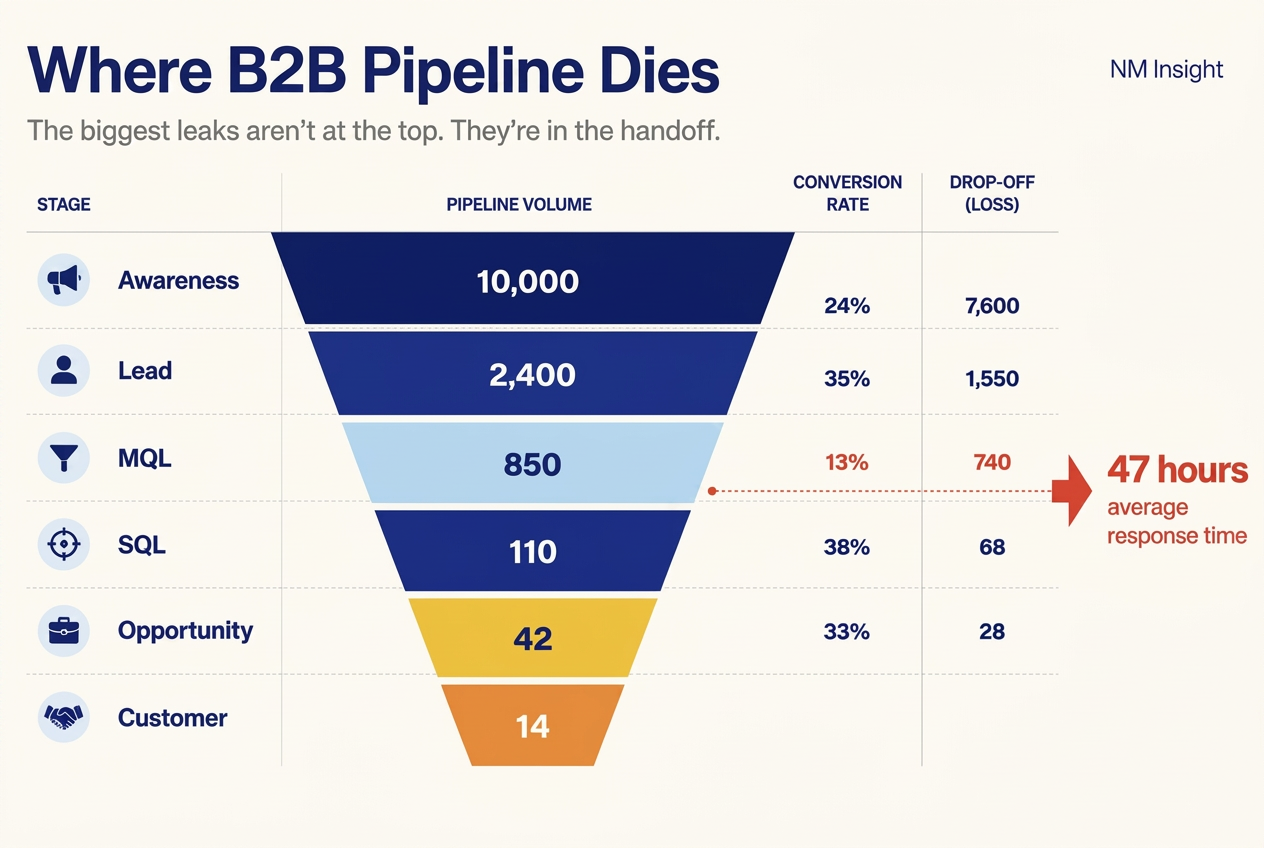
Fifteen years on, almost nothing has improved. Optifai's 2025-2026 benchmark of 939 B2B companies found an average response time of 47 hours, with only 23% of companies responding within five minutes and 42% taking more than a day. The close-rate gradient tracks the delay almost linearly: leads contacted in under five minutes closed at 32%, versus 12% after 24 hours - a 2.6x swing with no change to the offer, the rep or the pitch.
The bottleneck has a name. First Page Sage's analysis of client data from 2019-2025 puts the cross-industry median MQL-to-SQL conversion rate at roughly 13%, ranging from about 11% in fintech to about 26% in HVAC and insurance. B2B SaaS specifically averages 18-22%, with top performers at 25-35%. The MQL→SQL step is where marketing's leads either become real pipeline or quietly die - and it is the single highest-ROI place to intervene.
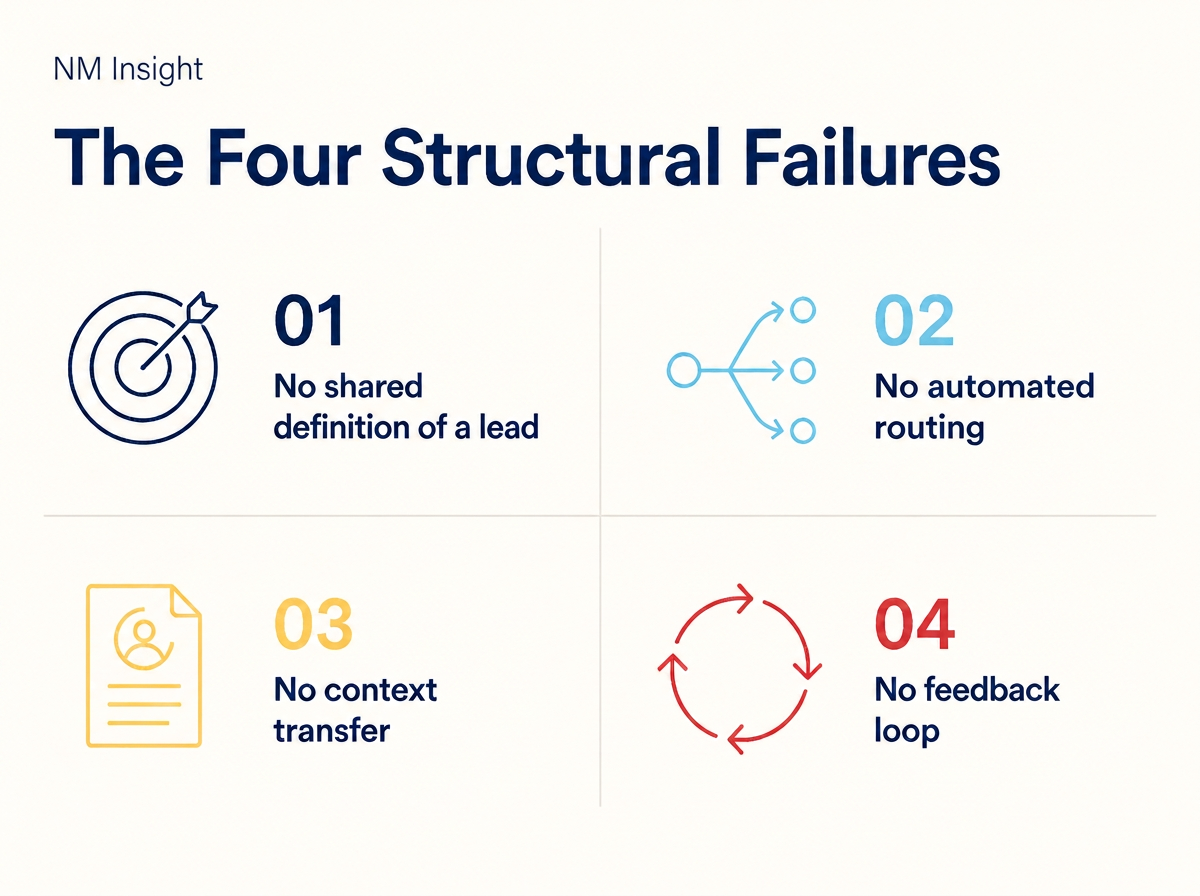
The Four Structural Failures
None of these is a culture problem. Each is a missing or broken object in the CRM.
- 01
No shared definition of a lead
Marketing ships MQLs against a threshold sales never agreed to. Sales rejects them. Both are being honest; they are measuring different things. This corrupts the MQL→SQL rate before anyone touches it.
- 02
No automated routing
A qualified lead sits in a queue because assignment is manual, or happens at the next weekly meeting. Against a five-minute window, a two-day handoff is a rounding error away from never.
- 03
No context transfer
The rep receives a name and an email, not the pages viewed, the content downloaded or the form answers. So the rep re-discovers what marketing already knew, burning the 5-6% of buyer time they were granted.
- 04
No feedback loop
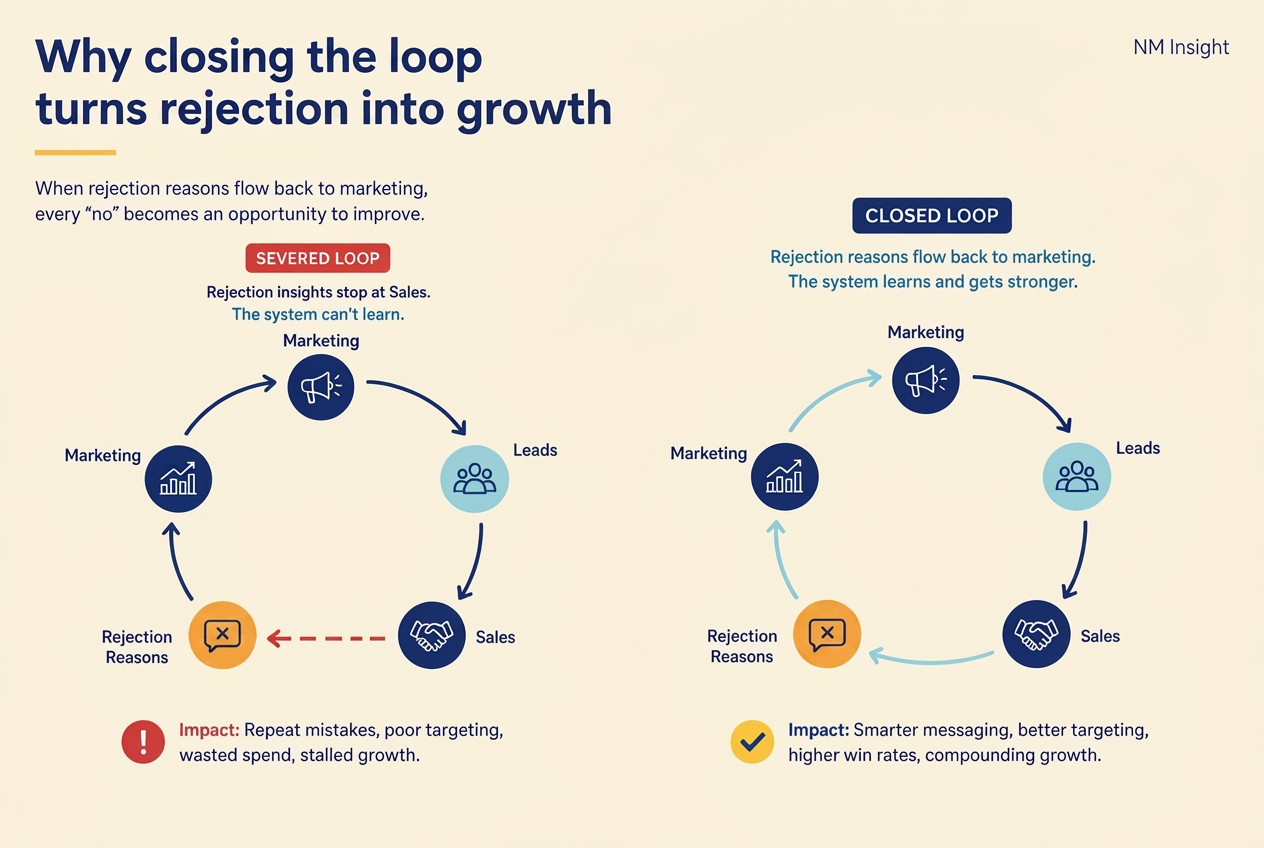
Sales rejects leads into a void. Marketing never learns which sources produce revenue, so it optimises for volume - more of exactly the leads sales rejects. The loop is severed at the rejection node.
Add a slow-acting accelerant: B2B contact data decays fast. Dun & Bradstreet's benchmark puts the rate at roughly 2.1% per month, compounding to about 22.5% a year (other estimates run to 30%) - so even a good lead becomes a bad record if it sits.
What the Fix Actually Looks Like: A Real-Case Walkthrough
Consider Nordwerk GmbH - an illustrative, fictional composite: a Berlin-based B2B SaaS company of about 25 people, with a four-person sales team selling a mid-ticket annual subscription (roughly €12,000 a year) to mid-market buyers across Germany, Austria and Switzerland. Nordwerk runs on HubSpot's free CRM. Marketing hits its MQL target every month. Sales complains, every month, that the leads are junk. The average time from form-fill to first sales touch is about two days.
Before
A prospect - a procurement lead at a mid-market manufacturer - downloads Nordwerk's pricing guide at 09:14 on a Tuesday. HubSpot Free captures the contact. Nothing routes it; owner assignment is manual. It surfaces at the Thursday pipeline meeting, is eyeballed, and assigned to a rep who emails on Friday afternoon - about 47 hours later, exactly the industry average and exactly the wrong side of every speed-to-lead curve. The rep sees a name and an email, not the three pricing-page visits. Marketing counted the download as an MQL; sales silently drops it as "not ready," with no reason recorded. Marketing's dashboard shows MQL target met. The pipeline shows nothing. Both teams are correct, and the company loses the deal.
After - built tier by tier
- 01
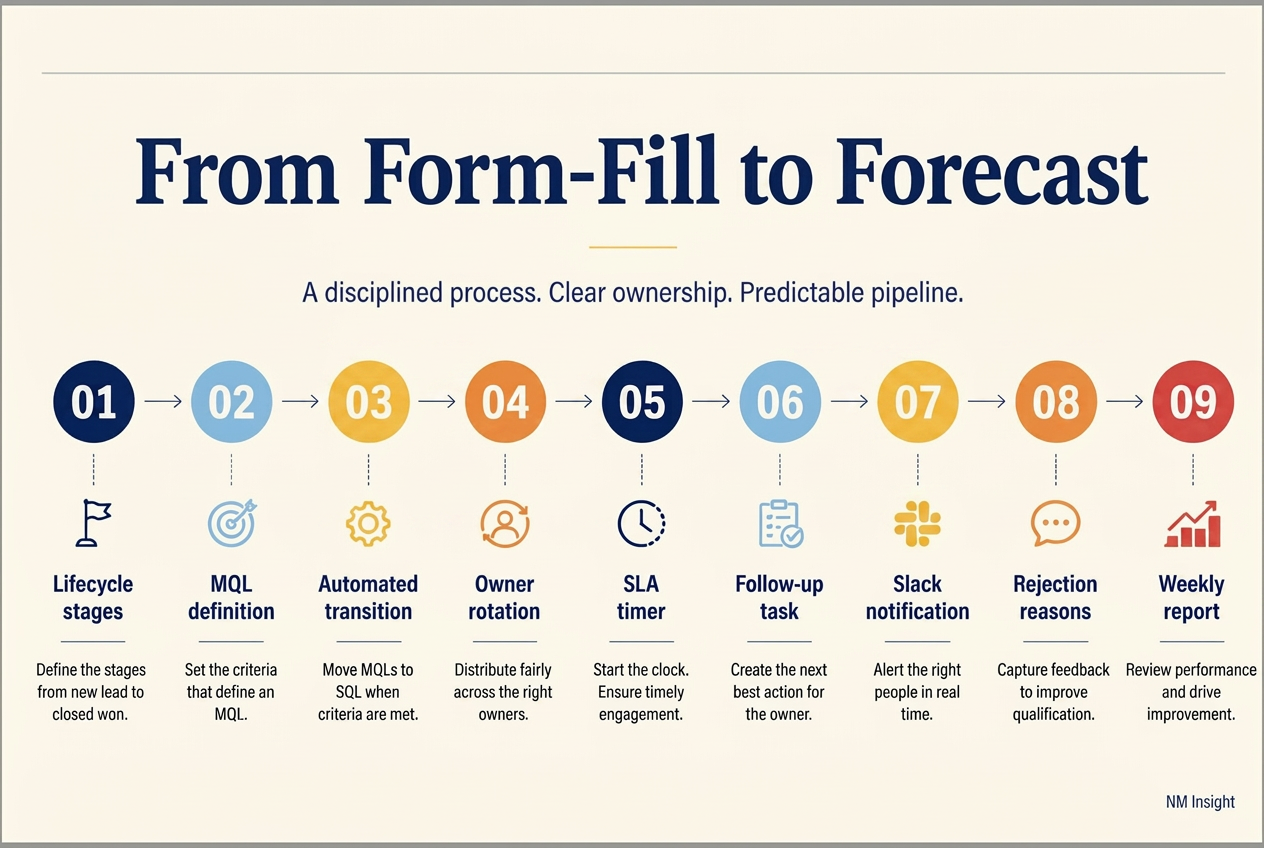
Document the lifecycle stages
In HubSpot: Settings → Data Management → Objects → Contacts → Lifecycle Stage. The eight defaults are Subscriber, Lead, MQL, SQL, Opportunity, Customer, Evangelist and Other. This costs nothing on Free. What Nordwerk does here is not technical - it is the treaty: marketing and sales jointly write down what each stage means and who owns the transition into it.
- 02
Define MQL jointly, and score it
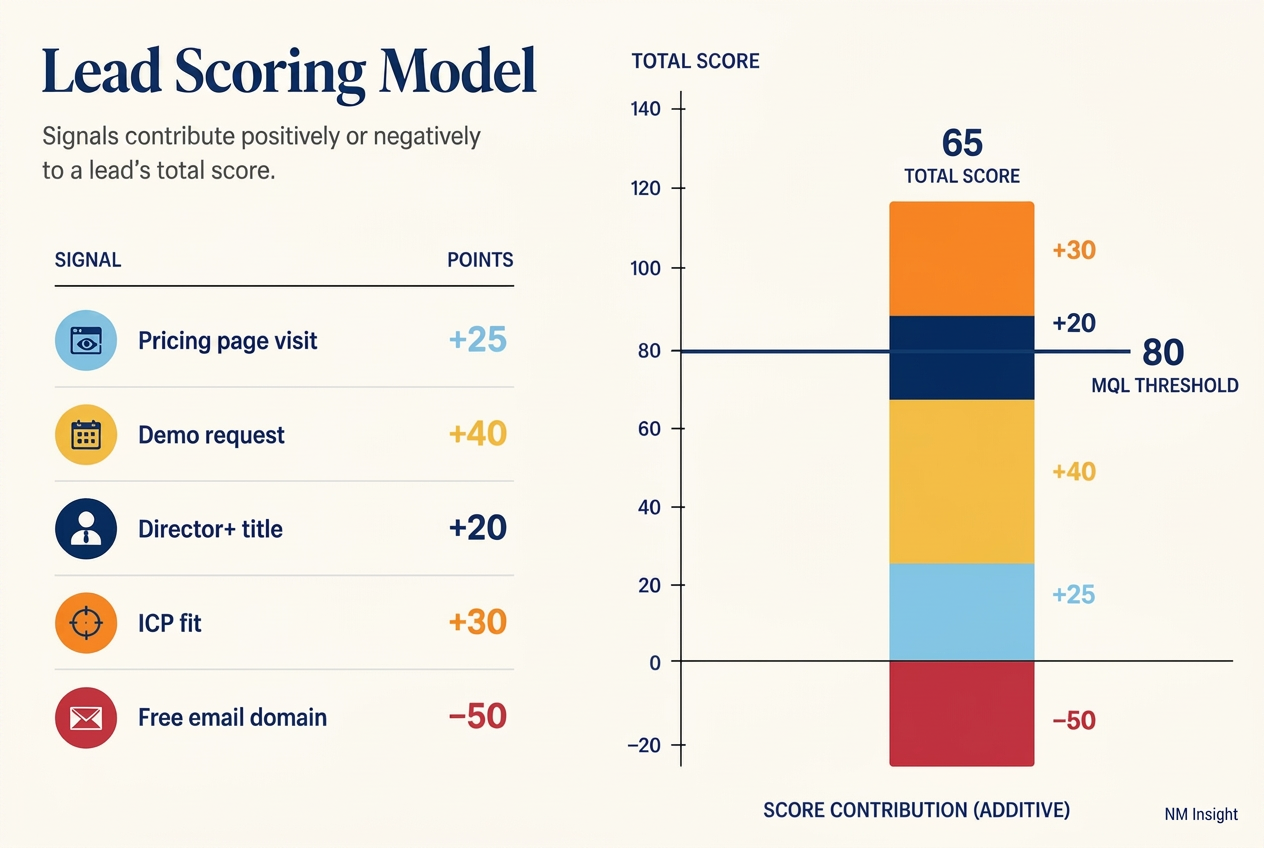
Manual model: pricing-page visit +25, demo request +40, Director-level title or above +20, ICP fit +30, student or free email domain -50. Threshold: 80. First hard wall: lead scoring is not available on HubSpot Free or Starter - it requires Marketing Hub or Sales Hub Professional. Predictive scoring is Enterprise-only.
- 03
Automate the lifecycle transition
Lead → MQL and MQL → SQL transitions do not happen on their own - they require a workflow. Second wall: multi-step workflows require Professional. The engine of the whole system is a paid feature.
- 04
Rotate to owner
Automation → Workflows → Create workflow (contact-based). Trigger on lead score ≥ 80 or lifecycle stage = MQL, then rotate the record to a sales owner. Round-robin owner rotation still requires Sales (or Service) Hub Professional or Enterprise, and each assignee must hold a paid seat.
- 05
Start the SLA timer
The moment the contact becomes an MQL, the stopwatch starts. HubSpot auto-generates "Date entered [stage]" timestamps; time-in-stage calculated properties are Professional. The target is written into the treaty: first touch within one hour, tracked, visible, owned.
- 06
Create the follow-up task
A task is created automatically on the assigned rep's queue with the lead's page-view history, form answers and score attached. The rep opens the record already knowing why marketing sent it.
- 07
Notify Slack/email
An internal notification fires so the SLA clock is not silent. Response time is a system property, not a hope.
- 08
Mandatory rejection reasons
Settings → Properties → Conditional logic → Create logic. When a rep disqualifies a lead, they must say why. Conditional property logic that enforces a required field is a Professional+ feature. This single node is what re-connects the severed feedback loop.
- 09
Weekly MQL→SQL reporting
Reporting → Reports → Funnels → Contacts, with stages Lead → MQL → SQL → Opportunity → Customer. Both teams work from one number, watching the MQL→SQL rate that used to be an argument.
Offline conversions back to the ad platforms. Marketing → Ads → Create event lets Nordwerk fire a conversion to Google Ads and LinkedIn when a contact reaches MQL, SQL or Customer - teaching the bidding algorithms to optimise for revenue-shaped events, not form-fills. Two operational notes matter. LinkedIn's Conversions API only credits conversions within 90 days of the ad click. And because Nordwerk's buyers are in the EEA, Google Consent Mode v2 has been mandatory since March 2024: personalised advertising and Customer Match uploads require the ad_user_data and ad_personalization consent signals to be granted, or the data cannot be used.
The Tier Verdict
Nordwerk's honest conclusion: HubSpot Free cannot run this system. Free gives you the lifecycle-stage vocabulary and the ability to create properties - the paperwork of alignment - but none of the automation, scoring, rotation, conditional-required fields or custom funnel reporting that make it real. Starter removes branding and adds light automation but still lacks all of the above. The system described here requires Professional (in 2026, Sales Hub Professional lists at roughly $100 per seat per month, and Marketing Hub Professional at roughly $890 per month including three seats, plus a one-time onboarding fee) - which for a 25-person DACH SaaS is a rational, and arguably overdue, purchase. Predictive scoring and custom objects sit up at Enterprise; Nordwerk does not need them yet.
Grounded in the benchmarks above - not in any real client result - Nordwerk's plausible trajectory is: response time falling from ~47 hours toward under one hour; MQL→SQL climbing from the low teens toward the mid-20s% typical of well-run B2B SaaS; and, for the first time, a defensible answer to "which marketing spend produced revenue?"
The cleanest publicly documented example is Advanced, a large UK business-software group, which (in an Adobe/Marketo customer story) consolidated a fragmented stack onto a defined lead-lifecycle model with funnel stages and nurture streams. The reported result: the conversion rate from SAL to SQL soared from 38% to 62%, with Marketo live within three months, 13 business units streamlined into one aligned function, and combined annual savings of £2 million.
The AI Layer
AI is genuinely arriving in these workflows. Microsoft and LinkedIn's 2024 Work Trend Index (an Edelman survey of 31,000 knowledge workers across 31 markets) found that 75% of knowledge workers use AI at work today, and 46% of users started using it less than six months ago. In the CRM, tools such as Salesforce's Einstein Conversation Insights already summarise calls, surface next steps and log sentiment straight onto the record; HubSpot's Breeze offers comparable moves.
What AI does well here is real: it summarises calls, updates CRM fields, extracts buying signals from conversations and drafts follow-ups. What it cannot do is design your lifecycle, define your MQL, write your SLA or build your routing. Those are decisions, not tasks. Point AI at a company that has made those decisions and it compounds a good system. Point it at Nordwerk's "before" state and it will route junk faster and summarise calls that should never have happened.
AI accelerates good systems. It also accelerates broken ones.
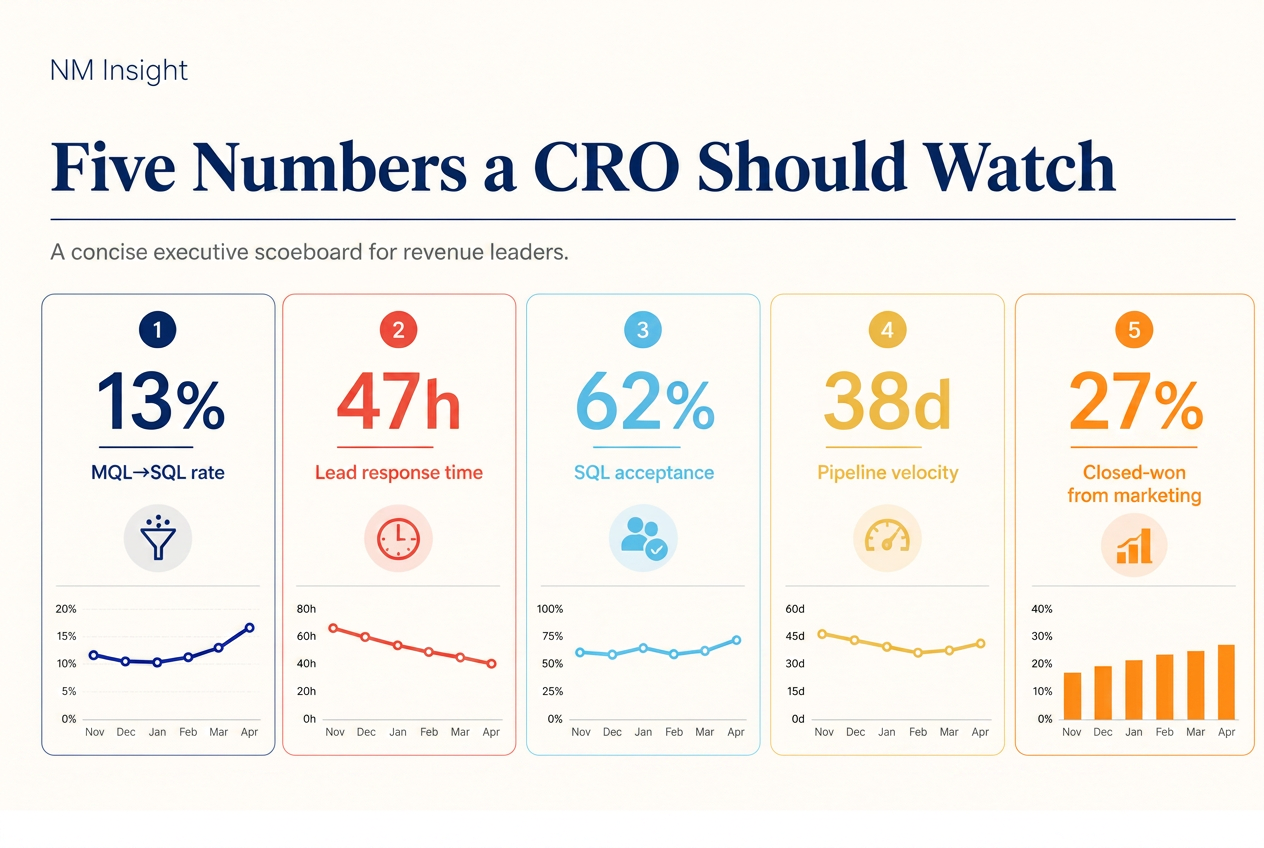
The Five Numbers a CRO Should Watch
- 01
MQL→SQL conversion rate
The master diagnostic. ~13% is the blended baseline; 25%+ is strong for B2B SaaS.
- 02
Lead response time vs SLA
Median and % within the one-hour target. Under five minutes is elite; 47 hours is the unacceptable industry default.
- 03
SQL acceptance rate
The share of MQLs sales accepts. Below ~70% means the MQL definition is broken, not the leads.
- 04
Pipeline velocity
Are qualified leads moving, or ageing into the ~22-30%-a-year data decay?
- 05
Closed-won from marketing-sourced leads
The only number that ends the "which team drove revenue" argument. The first four are worthless without this one.
The Reframe
Stop treating the CRM as a contact database with a sales tab. It is the operating system of the revenue engine - the place where the marketing-to-sales treaty is written in configuration rather than good intentions. Alignment is not a feeling the two teams achieve at an offsite. It is a set of objects: a shared lifecycle, a jointly-owned MQL definition, an automated route, an SLA timer, mandatory rejection reasons, a closed feedback loop and offline conversions flowing back to the ad platforms. Build those, and "alignment" stops being an aspiration and becomes a property you can query.
Your CRM is the real marketing tool. Everything else just fills it.
Operator's Playbook — 30-minute CRM Audit
- Are lifecycle stages documented?
- Is MQL defined jointly by Marketing and Sales?
- Does every MQL receive an owner automatically?
- Is there an SLA timer?
- Are rejection reasons mandatory?
- Are offline conversions sent back to Google Ads and LinkedIn?
- Is MQL → SQL tracked weekly?
- Is marketing measured on revenue, not just leads?
Estimated completion time: 30 minutes. If more than two boxes remain unchecked, your CRM is functioning primarily as a contact database rather than a revenue system.
Sources
Forrester 2024 Priorities Survey and Q2 2024 Sales & Marketing Alignment Survey; IDC misalignment cost estimate; SiriusDecisions/Forrester three-year growth study; Gartner 2017 Digital B2B Buyer Survey (restated 2024); Salesforce State of Sales 5th and 7th Editions; Oldroyd et al. Lead Response Management Study (MIT/InsideSales, 2007); Oldroyd, McElheran & Elkington, "The Short Life of Online Sales Leads" (HBR, March 2011); Optifai Lead Response Time Benchmark (939 B2B companies, Q2 2025-Q1 2026); First Page Sage MQL-to-SQL conversion by industry (2019-2025); Dun & Bradstreet B2B contact data decay; Microsoft & LinkedIn 2024 Work Trend Index; Salesforce Einstein Conversation Insights docs; Google Consent Mode v2 (mandatory March 2024); HubSpot Knowledge Base (lifecycle stages, lead scoring, workflows, owner rotation, properties and conditional logic, funnel reports, ad conversion events, 2026 pricing); Adobe/Marketo "Advanced" customer story; SuperOffice alignment case (framed with caveat).
Flagged as folklore/directional: "$1 trillion" (HBR contributor column, Dec 2021, no primary source); "208% more revenue" (Wheelhouse Advisors / MarketingProfs c.2010); "73% never contacted" (Channel Futures / CMIT, directional).
NM Editorial Team
Analysis and market intelligence from the NM Insight blog - focused on the infrastructure between acquisition and revenue.