
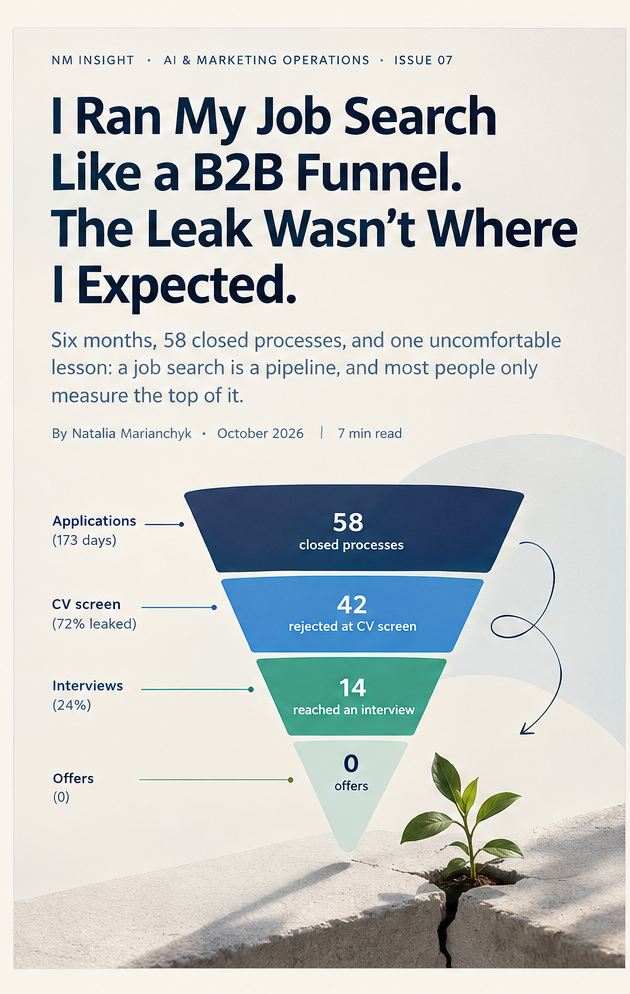
If you handed me a B2B pipeline with this profile, I would diagnose it in ten minutes. Plenty of activity at the top, a thin middle, almost nothing at the bottom, and no one tracking which stage actually leaks.
This was my own pipeline. For six months I applied, followed up, interviewed and waited, and I treated each rejection as a verdict on me. Then I did what I would tell any client to do: I stopped feeling the funnel and started measuring it.
The Funnel, Stated Plainly
Between 1 April and 30 September I logged every application, every interview-stage process and every rejection: 173 days of active searching. Written down the way I would write down a sales pipeline, it looks like this.
| STAGE | WHAT IT MEANS | COUNT |
|---|---|---|
| Closed processes | Applications that ended in a decision | 58 |
| Rejected at CV screen | No human conversation at all | 42 (72%) |
| Reached interview stage | One or more interview-stage conversations | 14 (24%) |
| Offers | A written offer | 0 |
Of the 14 processes recorded as reaching interview stage, 8 were confirmed through calendar entries only; no separate outcome was recorded in the tracker.
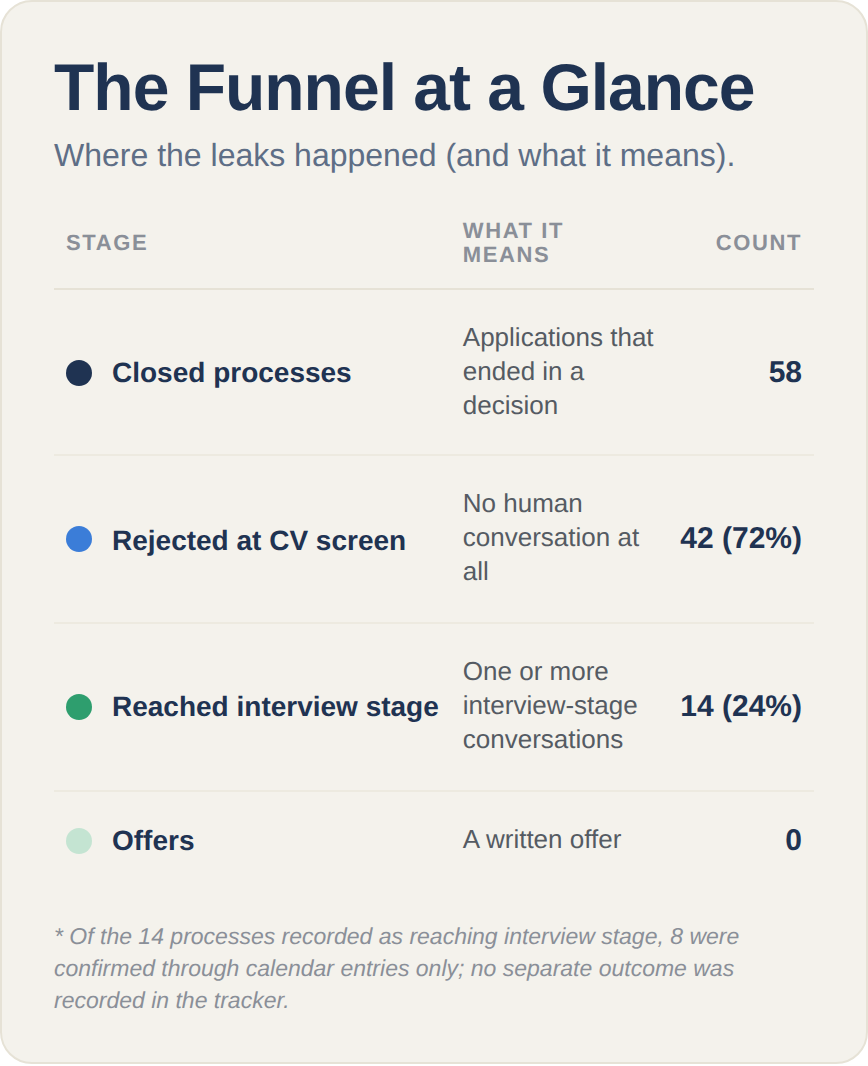
Three things stood out the moment the numbers sat in one place.
First, volume was not my problem: 173 days of active searching produced 58 closed processes.
Second, the drop between "applied" and "any reply" was steeper than at any later stage: 42 of 58 applications — 72% — ended at the CV screen, before a human spoke to me. In August alone I was screened out by names like TikTok, eBay and Expedia: sixteen rejections in a single month, not one conversation. None of those rejections named a gap in my experience. They used template language — "high volume of applications," "after careful consideration."
Third, one channel converted nothing: ten applications to generic "Marketing Manager" postings at large corporates produced zero interviews.
That was the part that surprised me. I had assumed rejection meant a weak profile. The data said something more precise: wrong channel at the top, under-prepared at the bottom — and those are two different problems.
For balance, the funnel wasn't all leaks. I reached multiple rounds at one of the biggest names in tech, including conversations in German. The process eventually ended with a six-month reapply window. For me, that settled one question: I could do the work. The problem was never whether I could do it. It was where I spent my effort, and how I told the story.
Where It Leaked
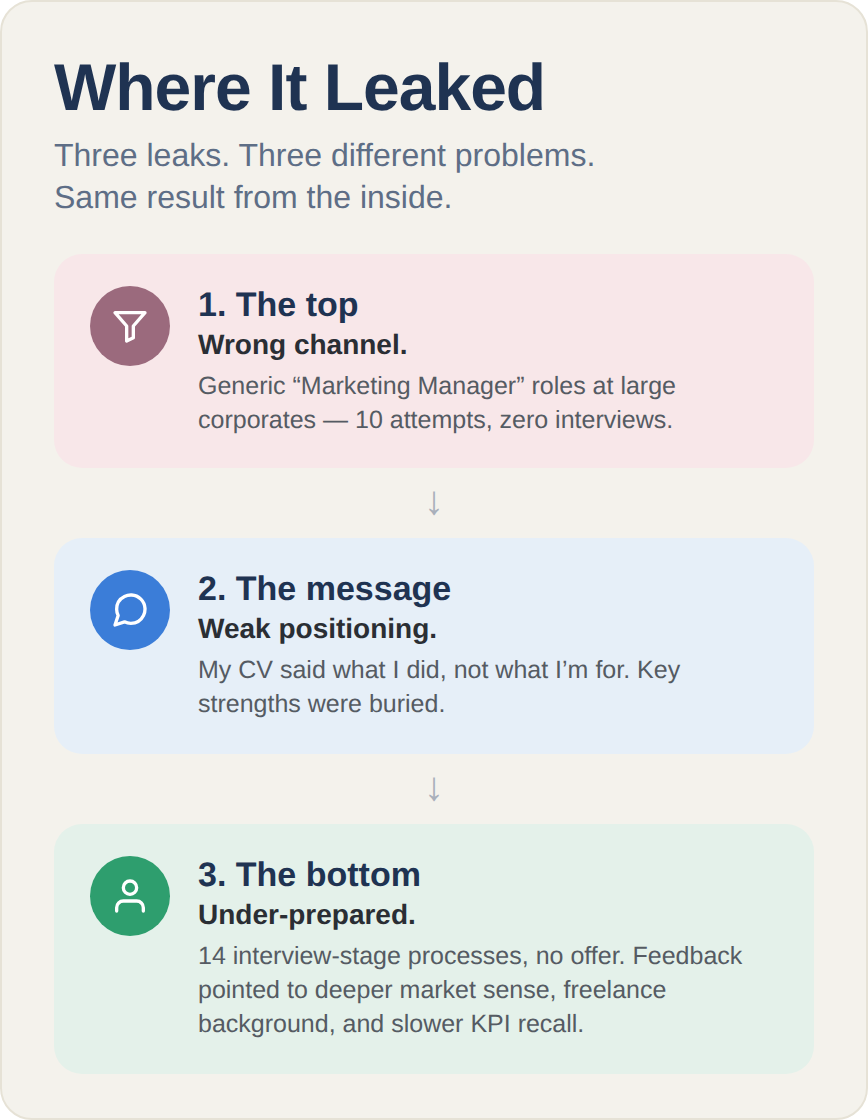
A funnel leaks for one of three reasons, and each needs a different fix. It took me an embarrassingly long time to separate them.
The leak at the top — wrong channel. 72% of my applications never reached a human. The pattern was clear: generic "Marketing Manager" titles at large corporates — ten attempts, zero interviews. These employers filter on keywords and years of experience before anyone reads the CV. I was spending my best hours in the channel with the lowest odds.
The leak in the message — weak positioning. My CV said everything I had done and never said what I am for. The label "B2B Performance Marketing Manager" buried the strongest things I had: an outbound system I built myself, journalism training, five working languages, and years of selling into technical and regulated buyers.
The leak at the bottom — under-prepared. Fourteen interview-stage processes, no offer. The feedback the data pointed to was specific: a wish for deeper market sense, a concern about a freelance background, and slower KPI recall under pressure. All of it is fixable, and none of it was visible until I stopped guessing.
A rejection tells you which stage failed. It does not tell you why — and guessing the why from how it feels is how people spend months fixing the wrong thing.
A note, written the week this goes out: one of my two most advanced processes just closed with a no, after a warm final-round conversation. Read as data, it points to the same place as the rest: the bottom of the funnel is the stage where I still have the most work to do. A rejection after a real conversation is information about the last 10%, not a verdict on the whole.
Five Changes, Same System
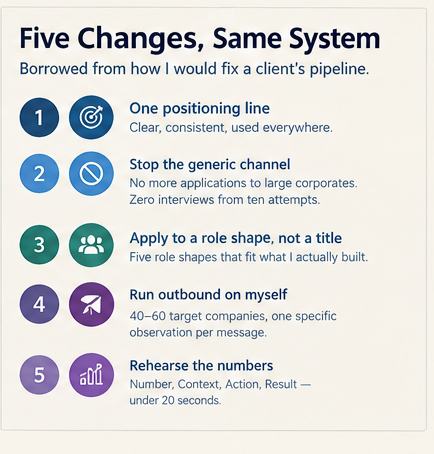
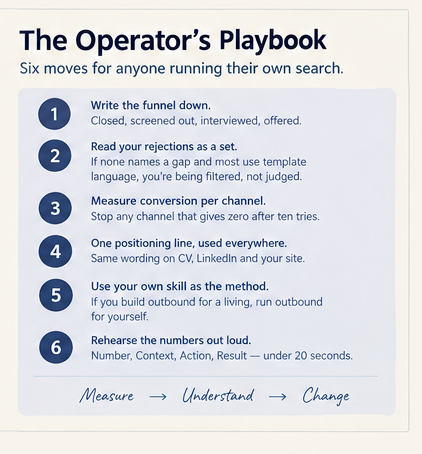
I made five changes, all borrowed from how I would fix a client's pipeline.
1. One positioning line. I needed a single line to test consistently during the experiment — something specific enough to measure, not a permanent rewrite of my identity. For the test I used: I build go-to-market systems — covering outbound, content and positioning — for B2B companies selling complex products to technical buyers in DACH and the EU. Role by role, the emphasis can still shift; the point was to stop telling a slightly different story every time.
2. Stop the generic channel. No more broad applications to "Marketing Manager" roles at large corporates. Zero interviews from ten attempts is a result, not bad luck.
3. Apply to a role shape, not a title. I narrowed to five shapes that fit what I actually built: GTM/Growth lead at an early-stage B2B SaaS or industrial-tech company; Head of Marketing at a 20–300-person scale-up; Content & Communications lead in B2B tech; Founding Marketer at a pre-seed/seed startup; and DACH market-expansion lead for an EU company entering the region. Each one maps to a real strength — the outbound system, the writing, the five languages — instead of a generic title.
4. Run outbound on myself. I built a target list of 40–60 companies in Apollo — 20–300 employees, selling complex products — found the decision-maker at each, and wrote with one specific observation about their go-to-market. The method is the proof: if I build outbound for a living, I should be able to run it for myself.
5. Rehearse the numbers. Every KPI answer now follows Number, Context, Action, Result — said out loud, in under 20 seconds.
It has been one week since I started running the new channel. That is too early to claim results. The old benchmark remains: 58 closed processes, 14 interview-stage processes, 0 offers. The next issue will report what happened after changing the system — either way. That's the whole point: a funnel you measure is one you can report on — to a client, or to yourself.
The Verdict
A job search is the only pipeline most people run without a dashboard. It is also the one where they take every data point personally.
The moment I treated it as a system, the feeling changed. A rejection stopped being a judgement and became a reading: this stage, this source, this message. That is easier to act on, and far easier to live with.
You cannot fix a funnel you only feel. Measure it, then decide what to change.
NM Insight · Issue 07

Natalia Marianchyk
Marketing Specialist at NM Insight - a Berlin-based marketing professional focused on the infrastructure between acquisition and revenue.