
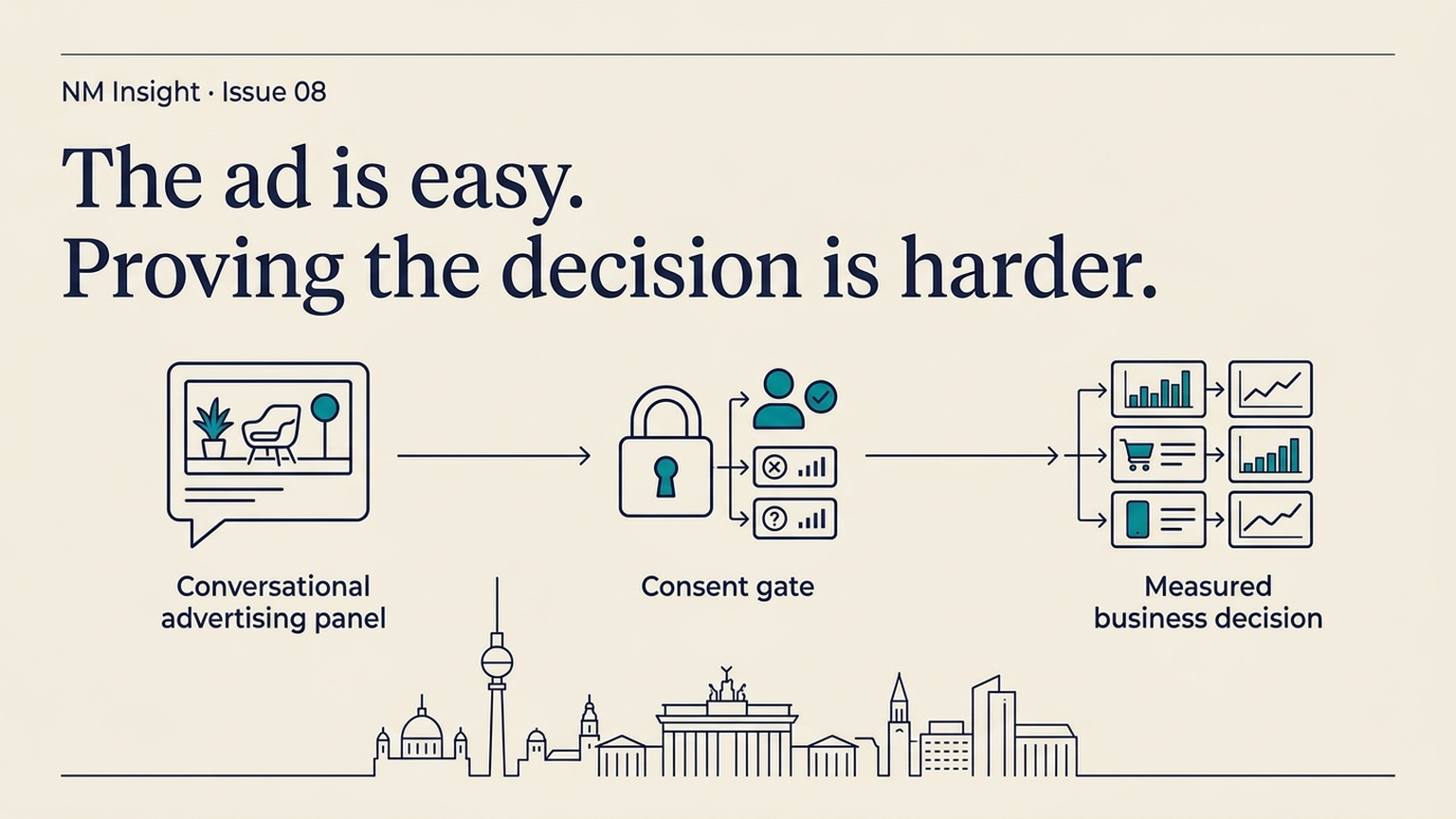
Germany Has a New Advertising Environment
The launch happened quickly.
OpenAI announced the European expansion on 18 August 2026, bringing ChatGPT Ads to 31 European markets including Germany. Ads began serving to eligible German users on 24 August. Self-service access through Ads Manager followed on 31 August.
Germany was therefore not a market waiting for a hypothetical AI advertising future. It became a live market in the second half of 2026.
The first evidence of how major advertisers are approaching it is already emerging. WPP Media says its German pilots began in late August with OpenAI and selected clients including Colgate-Palmolive, Ford, Henkel, RTL and Volksbanken Raiffeisenbanken. The agency describes the campaigns as experiments in a new research and decision environment, with current measurement focused on reach, clicks and available interaction data.
The more revealing part is what WPP says it wants to measure next.
Not just clicks.
Business outcomes.
The agency says it wants to move toward conversion signals and post-click behaviour as the channel develops. It also describes ChatGPT Ads as a complement to traditional search rather than a replacement for it.
That distinction matters.
The question is not whether ChatGPT will "kill Google."
It does not need to.
It only needs to capture a meaningful part of the process that happens before a traditional search click.
This Is Not Another Google Ads
The easiest way to understand ChatGPT Ads is to compare the underlying user behaviour with traditional search.
A conventional search might look like:
"best CRM for small business Germany"
A conversational interaction could be much longer:
"I run a 20-person B2B company in Germany. We currently use spreadsheets and HubSpot feels too expensive. We need something simple for sales tracking, email integration and reporting. What would you recommend?"
The second interaction contains substantially more information.
There is a company profile.
There is a use case.
There are constraints.
There is an implicit budget.
There is a comparison problem.
And there is an emerging decision.
OpenAI's advertising system is designed around this environment. Its current documentation says ad selection can consider the context and intent of the current conversation, the landing page, advertiser-provided context hints and targeting selections.
That means the basic planning question changes from:
Which keyword should I buy?
to:
In which situations should my brand be relevant?
WPP Media's German pilots make that shift explicit. The agency developed individual "Context-Hint" approaches for clients, describing situations, questions and needs where an offering could be relevant.
This is a meaningful change in advertising logic.
The advertiser is not simply buying a word.
The advertiser is trying to define a context in which the brand deserves to appear.
That makes conversational advertising closer to decision architecture than traditional keyword advertising.
The Audience Headline Is Bigger Than the Ad Audience
OpenAI says ChatGPT reaches more than 1 billion weekly active users globally. Those numbers demonstrate the speed of the platform's commercial development.
But they should not be confused with the addressable German advertising audience.
ChatGPT Ads are shown only to logged-in adult users on Free and Go plans. Plus, Pro, Business, Enterprise and Edu accounts remain ad-free.
That creates an unusual segmentation issue.
The people who use ChatGPT most intensively for professional work may disproportionately sit outside the advertising audience.
For B2B marketers, this is particularly important.
A company selling enterprise software might find that some of its most commercially valuable ChatGPT users are paying subscribers, while its paid advertising inventory is concentrated elsewhere.
This does not make the channel irrelevant.
It means that ChatGPT usage and ChatGPT ad reach are not the same market.
A media plan should therefore distinguish between:
- total ChatGPT usage
- Free and Go users
- eligible users in Germany
- users engaging in commercially relevant conversations
- users who actually encounter an ad
- users who click
- users who eventually convert
The funnel becomes narrower as soon as you move from platform reach to advertising reach.
That is not a weakness unique to ChatGPT.
It is simply something marketers need to measure before turning a global user number into a media forecast.
Europe Gets a Different Version of ChatGPT Advertising
The European version of the advertising system also matters.
OpenAI currently says personalized ads are not initially available in the European Economic Area or Switzerland. In this environment, ads can be selected using the context of the current chat thread and basic information such as approximate location or language, without using broader personalization signals in the same way.
This is strategically important.
It means that the European advertising proposition is currently closer to contextual conversational advertising than to the full behavioural personalization model being developed elsewhere.
That could actually become one of the defining characteristics of the European market.
German advertisers have spent years adapting to a marketing environment in which consent, data minimization and first-party measurement constrain the assumptions built into global advertising technology.
ChatGPT does not remove those constraints.
It brings them into a new interface.
And regulators are already watching.
In October, the Berlin Commissioner for Data Protection and Freedom of Information warned about OpenAI's planned personalized advertising model, particularly the possibility of using current and previous chats, device information and usage data to construct profiles for advertising.
The Hamburg regulator described the planned approach as "hyper-personalised" advertising and highlighted the sensitivity of using chat histories to build user profiles.
The Lower Saxony data protection authority made a similar point, warning that people increasingly use AI chatbots for highly personal topics and may therefore disclose information that is much more intimate than a conventional search query.
This creates an important distinction for marketers:
Contextual relevance is not the same thing as behavioural profiling.
And in Germany, that distinction is likely to remain commercially important.
The Measurement Problem Moves Upstream
Advertising is relatively easy to launch.
Measurement is harder.
OpenAI's current Ads Manager reporting includes impressions, clicks, spend, CTR, average CPC, average CPM and conversions. Advertisers can also use static tracking parameters such as UTMs to identify ChatGPT traffic in existing analytics systems.
That is enough to build a basic performance dashboard.
It is not enough to answer every strategic question.
Imagine a German retailer launches ChatGPT Ads.
The dashboard reports:
1,000,000 impressions
20,000 clicks
2% CTR
€1.2 CPC
800 conversions
Those numbers tell the team what happened inside the advertising system.
They do not necessarily tell the team what would have happened without the advertising.
That is the difference between attribution and incrementality.
The problem is familiar. Marketing research consistently finds that proving ROI remains one of the hardest measurement challenges, even as teams invest more in testing and incrementality methods.
ChatGPT Ads make this problem more visible because the user journey itself is less conventional.
A person might:
- ask ChatGPT for advice
- see a brand
- continue asking questions
- search elsewhere
- visit the brand directly
- return through Google
- speak to sales
- convert weeks later
Which system gets the credit?
The ad platform?
Google?
Direct traffic?
CRM?
Sales?
The answer will rarely be contained in a single dashboard.
This is where the ChatGPT story connects to a much broader marketing problem.
If the CRM, analytics platform, advertising platform and website do not agree about what constitutes a qualified lead, adding another advertising environment simply adds another source of ambiguity.
ChatGPT Ads do not create these problems.
They expose them.
That is why the order of operations matters.
Do not start with the campaign. Start with the measurement question.
For example:
- Are we trying to generate incremental demand?
- Are we trying to influence consideration?
- Are we trying to generate direct conversions?
- Are we trying to reach new customers?
- Are we trying to improve branded discovery?
- Are we trying to reach people before they search for a specific supplier?
Each objective requires a different measurement design.
And the question marketers ultimately need answered is not:
"How many people clicked?"
It is:
"How many outcomes happened because we were there?"
OpenAI is already moving in this direction, partnering with measurement providers on geo-based experiments designed to estimate the causal impact of ChatGPT Ads. The company describes this work as still being in its early stages.
That is arguably more important than another dashboard metric.
Because influence can happen inside the conversation before the click.
A user may ask:
"Which CRM should I choose?"
The advertiser might appear.
The user might not click.
But the brand could nevertheless become one of the options considered later.
That is a form of influence that conventional click-based measurement can easily miss.
The implication is significant:
The click may become a weaker proxy for commercial value as AI becomes part of discovery.
AI Commerce Changes the Website's Job
It would be a mistake to treat advertising as the entire commercial story.
The advertising layer is developing alongside a broader AI commerce infrastructure.
OpenAI has integrated ChatGPT Ads with Shopify and HubSpot. The Shopify integration connects product catalogue and commerce-event data to Ads Manager, while the HubSpot integration allows advertisers to create campaigns, add leads to the CRM, trigger follow-up workflows and view performance alongside other channels.
The direction of travel is:
conversation → discovery → recommendation → click → CRM → conversion
The boundaries between advertising, commerce and customer relationship management become less distinct.
That changes the role of the website too.
Not because websites disappear.
But because they increasingly become evidence and infrastructure for systems that help people make decisions.
Research on AI-driven e-commerce discovery reinforces the point. In one 2026 study of large retailers, more than half of tested shopping queries produced an AI answer that did not include the retailer being tested, and nearly half of retailers had product pages without detected AI-readable structured data such as JSON-LD.
The important point is not whether every retailer should immediately adopt another acronym such as GEO.
The underlying issue is simpler:
Can an AI system understand what you sell?
Structured product information, clear attributes, availability, pricing, category information and useful comparison content become more important when discovery happens through an AI intermediary.
The website is no longer guaranteed to be the first destination.
It becomes the source layer that helps machines understand the company, product and proposition.
That is a different role.
What German Advertisers Should Actually Do Now
The wrong response to ChatGPT Ads is to immediately create another campaign and compare CPC with Google.
The better response is to treat the channel as a controlled experiment.
1. Define the decision you want to influence
Do not start with impressions.
Start with the commercial moment.
What question should make your brand relevant?
For example:
- choosing software
- comparing insurance
- planning a renovation
- researching a car
- selecting a financial product
- choosing a destination
- comparing consumer products
The more clearly the commercial situation is defined, the more useful contextual advertising becomes.
2. Separate total ChatGPT reach from ad-eligible reach
Remember that Free and Go users are the current advertising audience.
Do not use total ChatGPT usage as your media denominator.
For B2B campaigns, this distinction is particularly important.
3. Build the consent architecture before the campaign
If your measurement setup relies on cookies, pixels or other technologies that require consent under the applicable German privacy framework, the consent logic needs to be established before activation.
Do not treat measurement as something to add after launch.
The advertising platform may be new.
The compliance obligation is not.
4. Connect Pixel, conversion measurement and analytics deliberately
OpenAI supports conversion measurement and UTM parameters.
That gives marketers a starting point.
But the important question is whether the resulting events can be reconciled with:
- GA4
- CRM data
- qualified leads
- revenue
- customer acquisition cost
- customer lifetime value
If those systems disagree, the campaign report will not magically resolve the problem.
5. Define the primary business KPI before launch
Possible metrics include:
Awareness: reach, impressions, frequency
Engagement: clicks, CTR, CPC
Acquisition: conversions, CPA
Commercial quality: qualified leads, pipeline, revenue
Incrementality: incremental conversions, incremental revenue, new-customer share
The further down this list you go, the more strategically useful the measurement becomes.
6. Establish a baseline
Before spending heavily, understand what normally happens without ChatGPT Ads.
Otherwise, a post-campaign conversion count tells you very little.
7. Treat early campaigns as experiments
The channel is still developing.
WPP Media itself describes the German pilots as a learning environment and says longer-term benchmarks still need to be established.
That means the correct mindset is not:
"What is the benchmark CPC?"
It is:
"What can we learn about this environment that will improve our next decision?"
The Bigger Marketing Problem Is Not AI. It Is Data
This may be the most important lesson.
Marketers are already overwhelmed with data.
The problem is not that there are too few dashboards.
The problem is that the dashboards often describe different parts of reality.
AI does not eliminate this infrastructure problem.
It increases the speed at which the problem becomes visible.
A fragmented data foundation means faster fragmentation.
A weak measurement framework means faster reporting.
Bad inputs do not become strategic intelligence simply because an AI model is connected to them.
That is precisely the challenge facing ChatGPT Ads.
The New Advertising Unit May Be the Decision
For more than a decade, digital advertising has been optimized around increasingly precise versions of the same basic units:
impression
click
conversion
But conversational AI introduces another possible unit:
the decision
A person asks a question.
They explain their situation.
They compare alternatives.
They narrow their options.
They ask for a recommendation.
That is not simply a search query.
It is a decision process.
ChatGPT Ads enter that process.
This does not mean every conversation is commercially valuable. Nor does it mean an advertiser can simply buy a recommendation.
OpenAI explicitly separates ads from the model's answers and says advertisers cannot shape, rank or alter those answers.
That separation is essential.
But it also makes the advertising proposition more interesting.
The advertiser is paying to participate in the environment around the decision, not to control the decision itself.
The commercial value therefore depends on whether the brand is relevant enough to earn attention at that moment.
And that is why Context Hints, structured product data, landing pages, CRM integration and measurement infrastructure all suddenly belong in the same conversation.
They are different parts of one system.
What Comes Next
ChatGPT Ads are likely to become only one component of a broader AI commercial stack.
OpenAI is already testing Sponsored Agents that allow users to begin a conversation with a business-sponsored agent after clicking an ad. The feature is currently limited to selected advertisers in a limited alpha.
OpenAI is also expanding visual advertising formats and measurement partnerships.
Commerce integrations are moving closer to the same infrastructure.
But there is a danger in interpreting every new feature as another reason to add another tool.
The more important question is whether the underlying customer journey is becoming more coherent.
Conclusion: The Measurement Problem Has Moved
The first wave of digital advertising was about finding audiences.
The second was about targeting them more precisely.
The next phase is increasingly about participating in the moment when people make decisions.
ChatGPT Ads matter because they place advertising inside that moment.
But this does not eliminate the measurement problem.
It moves the measurement problem closer to the point of decision.
That is why the most important ChatGPT Ads capability for German marketers may not ultimately be another creative format, targeting option or bidding feature.
It may be the ability to answer a much harder question:
Did our presence change what happened next?
For German advertisers, that question comes with another one:
Can we measure it without breaking the privacy model that makes the market viable in the first place?
The companies that answer both questions will have an advantage.
Not because they were first to buy ChatGPT Ads.
But because they were first to build the infrastructure required to understand what conversational advertising actually does.
Five Takeaways
1. ChatGPT Ads are already a German market reality.
The question is no longer whether they will arrive, but how strategically they should be used.
2. This is not simply another search channel.
The advertising environment is built around conversational context and decision-making rather than a short keyword query.
3. Germany gets a particularly important privacy layer.
The EEA currently has a more limited personalization model, while German regulators are already scrutinizing the next stage of chat-based profiling.
4. Attribution will not be enough.
The broader marketing industry continues to struggle with proving ROI, and conversational advertising makes incrementality harder to ignore.
5. The competitive advantage may sit underneath the ad.
Structured product information, clean data, CRM integration, consent architecture and clear measurement will determine whether a new AI channel becomes a strategic asset or simply another dashboard.
Editorial source base
This analysis draws on:
- OpenAI, ChatGPT Ads expands across Europe, August 2026
- OpenAI, A milestone in expanding access to AI, August 2026
- OpenAI, Ads in ChatGPT, current documentation
- OpenAI, Building advertising for the way people use AI, October 2026
- OpenAI, Building ChatGPT's novel ad stack for user trust and relevance, October 2026
- OpenAI, Reimagining advertising with AI, September 2026
- WPP Media, German ChatGPT Ads pilot announcement, October 2026
- Berliner Beauftragte für Datenschutz und Informationsfreiheit, October 2026
- Landesbeauftragter für den Datenschutz Niedersachsen, October 2026
- Hamburgischer Beauftragter für Datenschutz und Informationsfreiheit, October 2026
- Supermetrics, The 2026 Marketing Data Report
- CMO Insights, CMO Insights Report 2025
- Boost.space Research, The State of AI in E-commerce 2026
- NM Insight editorial analysis

Natalia Marianchyk
Marketing Specialist at NM Insight - a Berlin-based marketing professional focused on the infrastructure between acquisition and revenue.